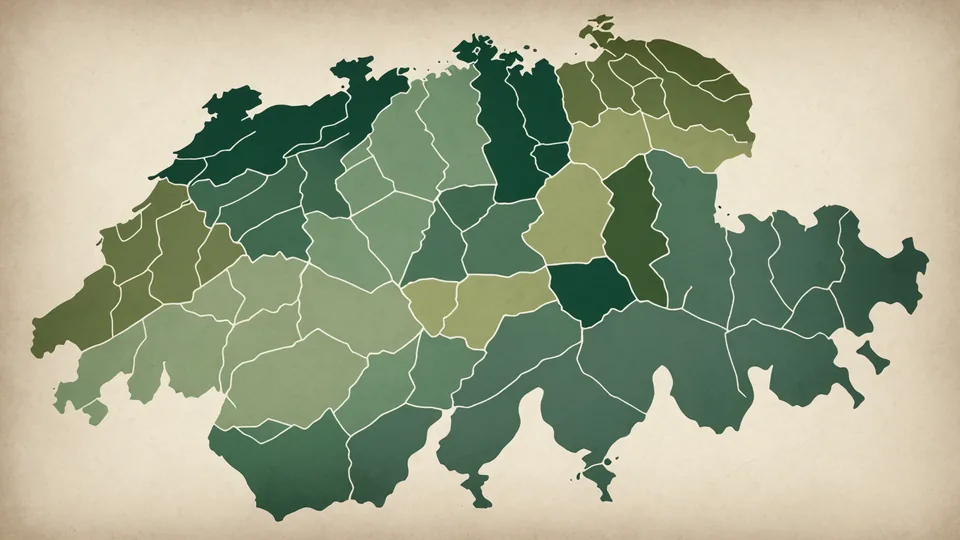
One of the things we underestimated when we started building Silex Legal was the scale of variation between cantonal court databases. We knew that cantonal courts published their own decisions independently. We had not fully appreciated that "published independently" meant 26 separate systems with different formats, different coverage years, different search interfaces, and different publication criteria, none of which were designed to interoperate.
This piece describes what we found when we started systematically working through those databases, why the variation matters for legal research, and what the realistic state of aggregated cantonal precedent looks like for practitioners today.
The 26-Database Problem
Each Swiss canton operates its own appellate court, and most publish decisions through a canton-specific interface. The Zurich Obergericht has a reasonably complete online decision database covering decisions from the early 2000s forward, with full-text search. The Bern Obergericht publishes decisions in a separate system with different search parameters. Smaller cantons may publish only selected decisions, or may have databases with coverage only from 2010 or later. Some cantons maintain their own legal portals; others link to Swisslex or similar aggregators for some of their output.
The variation extends to format. Some cantonal databases provide full-text decisions in PDF. Others provide HTML summaries with the reasoning condensed. A few provide only the operative part (Dispositiv) with no reasoning at all for certain case categories. The metadata quality varies similarly: some databases index by provision cited, which makes a search for "decisions on Art. 97 OR" straightforward. Others require free-text search through the decision body, which misses decisions that cite the provision in passing rather than as a heading.
We are not saying this variation is intentional or unreasonable. Cantonal courts are cantonal institutions, and their publication practices reflect cantonal administrative choices made over decades. But for a practitioner trying to determine how cantonal appellate courts across Switzerland have treated a specific federal law provision, the variation is a genuine research obstacle.
Coverage Gaps That Matter
Several coverage patterns create specific risks for researchers relying on cantonal databases:
Temporal coverage gaps: many cantonal databases do not extend before 2005. For established contract law provisions that have been interpreted repeatedly since the 1990s, the pre-2005 cantonal case law is invisible in current database searches. A practitioner who researches Art. 97 OR on a canton's database and finds no decisions before 2008 is not seeing an absence of cantonal interpretation; they are seeing a coverage boundary.
Selective publication: cantonal courts in Switzerland do not have a blanket obligation to publish all decisions. Publication criteria vary. In practice, many routine first-instance and even appellate decisions are not published, or are published only in summary form. A database search that returns 12 results for a provision may represent a fraction of the decisions on that provision within that canton over the same period. The unpublished decisions are not accessible through the database and require court record requests, which is a significant research escalation.
Language boundary effects: decisions from German-speaking cantons are in German, French-speaking cantons in French, Italian-speaking cantons in Italian. A practitioner searching a canton's database for an OR provision may conduct their search in the wrong language if the database treats the provision abbreviation differently across language versions. Art. 97 OR in a German search and art. 97 CO in a French search for the same provision in a bilingual canton may return different result sets depending on how the database indexes citations.
What Aggregation Actually Requires
Aggregating cantonal precedent across the 26 cantons for a specific OR provision is not a single search operation. It is a sequence of 26 separate searches, each adjusted for the specific canton's database format, search interface, language, and coverage parameters. The results must then be de-duplicated (some decisions appear in both the cantonal database and in commercial aggregators like Swisslex), normalized for format (PDF decisions versus HTML summaries), and filtered for relevance.
For a practitioner billing time, this sequence is rarely worth performing in full for routine matters. The practical result is that practitioners typically search the cantons most directly relevant to their matter (the canton where proceedings will occur, and perhaps the one or two cantons whose appellate courts are most active in the relevant practice area) and treat the remaining cantons as a research gap they accept.
This is a rational response to a real cost-benefit constraint. We are not saying practitioners should change their workflow absent better tooling. The point is that the phrase "cantonal precedent on Art. 97 OR" in practice means "a selected subset of cantonal decisions from a subset of cantons that are accessible in current databases," which is a narrower proposition than "what Swiss cantonal courts have actually decided on Art. 97 OR."
How Silex Legal Approaches the Problem
When we describe Silex Legal's cantonal coverage, we describe it specifically rather than in aggregate terms, because an aggregate description like "covers all 26 cantons" implies a uniformity that does not exist in the underlying data. The honest description is: we have indexed the publicly accessible decision databases for each canton, we have noted the coverage years and format limitations, and we surface those limitations in results so practitioners know whether a result set represents strong coverage or partial coverage for a given canton.
In cantons where the database extends back to 2003 with full-text decisions indexed by provision, we can return substantially complete coverage of recent appellate decisions on a provision. In cantons where the database is post-2015 and uses summary format only, the coverage is shallower and the limitation is visible in the interface.
This is different from claiming to "solve" the 26-database problem, which we have not done. What we have done is make the coverage map explicit, so practitioners can see what they are working with rather than making implicit assumptions about completeness that the underlying data does not support. For a practitioner deciding whether to rely on Silex Legal's cantonal results or conduct their own supplementary search in a canton's native database, that coverage transparency is what they need to make the decision.
The Commercial Aggregator Landscape
The commercial Swiss legal information market has two major providers: Swisslex and Legalis. Both aggregate Federal Tribunal decisions comprehensively. Both include some cantonal decisions, but the cantonal coverage in both varies by canton and is not fully documented for practitioners relying on them.
Neither Swisslex nor Legalis makes its cantonal coverage maps publicly available at the decision-database level. A practitioner using one of these platforms for a cantonal precedent search cannot easily determine whether a "no results" response means "no relevant decisions were published" or "the relevant decisions were not indexed in this database." This ambiguity in commercial platforms is one of the persistent quality problems in Swiss legal research infrastructure, and it is the gap that motivated our work on Silex Legal's explicit coverage documentation.
We are not saying commercial platforms do poor work. For Federal Tribunal decisions and federal statutory text, both platforms provide reliable, well-maintained coverage. The cantonal layer is where the coverage transparency problem is most acute and where a research tool that makes its limitations explicit adds disproportionate value over one that surfaces results without noting where the gaps are.